
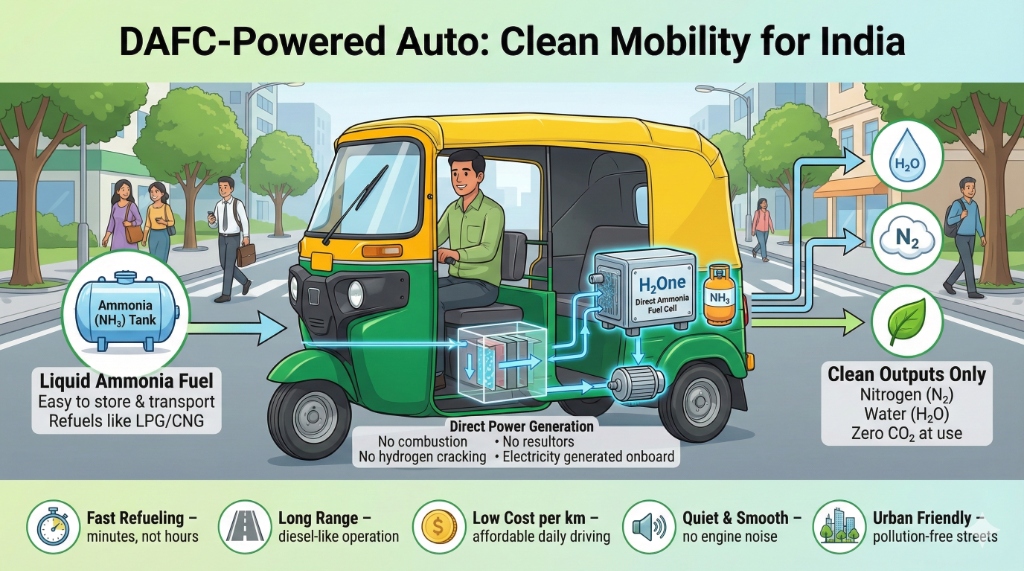
H₂One is developing Direct Ammonia Fuel Cell (DAFC)–powered auto rickshaws that offer a practical, clean alternative to petrol, diesel, CNG, and battery-electric vehicles.
Unlike battery EVs that require long charging times or hydrogen systems that need complex infrastructure, DAFC autos generate electricity directly from ammonia — a liquid fuel that is easy to store, transport, and refuel.
This enables fast refueling, long driving range, and low operating cost, making clean mobility viable for India's urban and semi-urban transport needs.
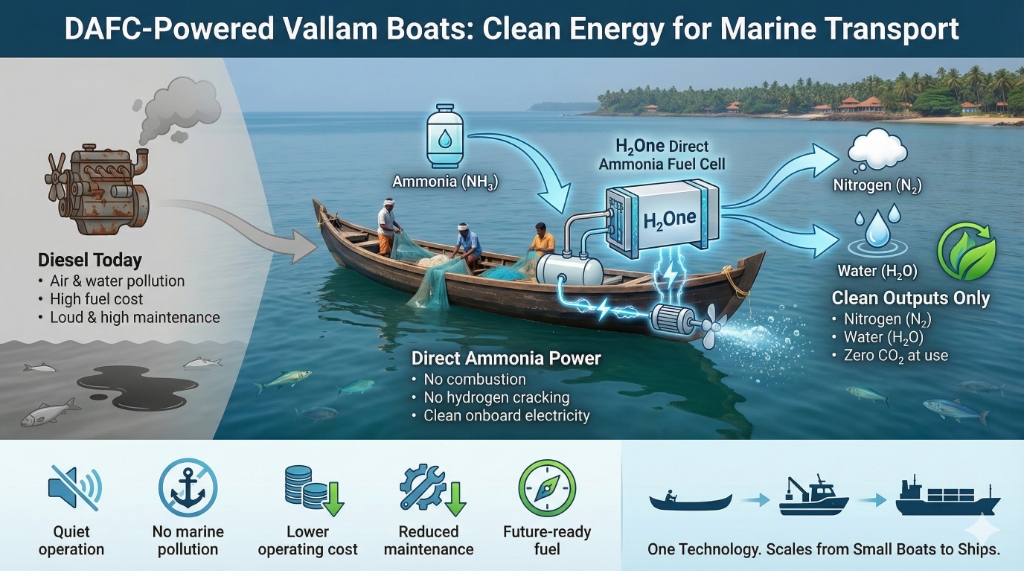
H₂One is developing Direct Ammonia Fuel Cell (DAFC) systems for vallam boats and small fishing vessels, addressing one of the most diesel-dependent and pollution-intensive segments of coastal and inland waterways.
Traditional diesel engines used in vallams cause air and water pollution, high fuel costs, noise, and maintenance challenges. DAFC offers a clean, quiet, and fuel-efficient alternative, generating electricity directly from ammonia without combustion or hydrogen cracking.
Initial deployments focus on vallam boats and small marine craft, with a clear and modular pathway to larger boats, harbor vessels, and ship auxiliary power systems as power capacity scales.
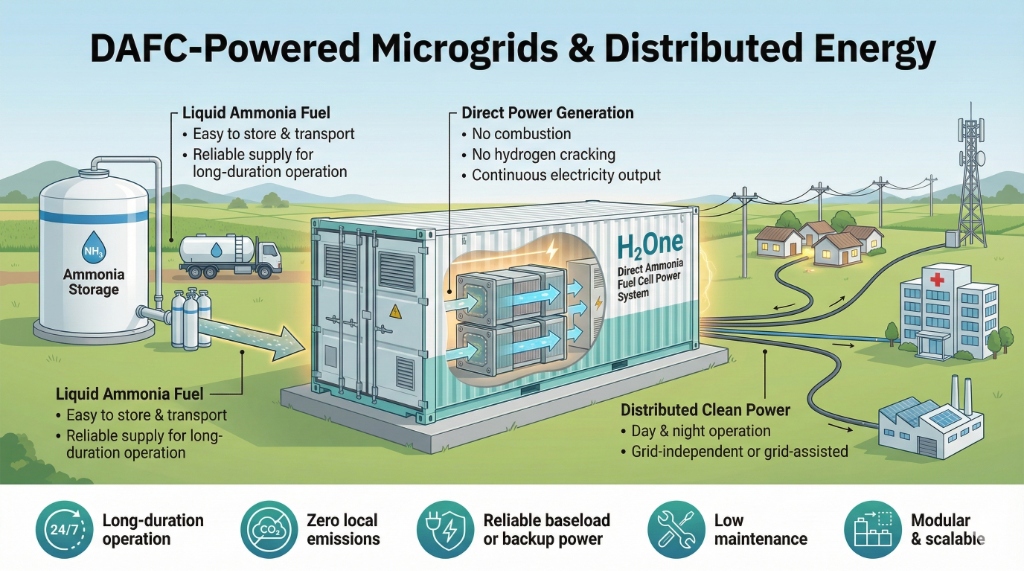
H₂One's Direct Ammonia Fuel Cell (DAFC) systems provide reliable, long-duration electricity for microgrids and distributed power applications, especially in locations where grid supply is unreliable, intermittent, or unavailable.
Unlike diesel generators that emit pollutants or battery systems limited by charging and storage duration, DAFC generates electricity continuously from liquid ammonia, a fuel that can be stored and transported like LPG. This makes DAFC suitable for critical infrastructure, remote facilities, and community power systems that require dependable energy day and night.
DAFC-based microgrids can operate independently or alongside renewable sources, offering clean baseload or backup power without combustion or complex hydrogen infrastructure.
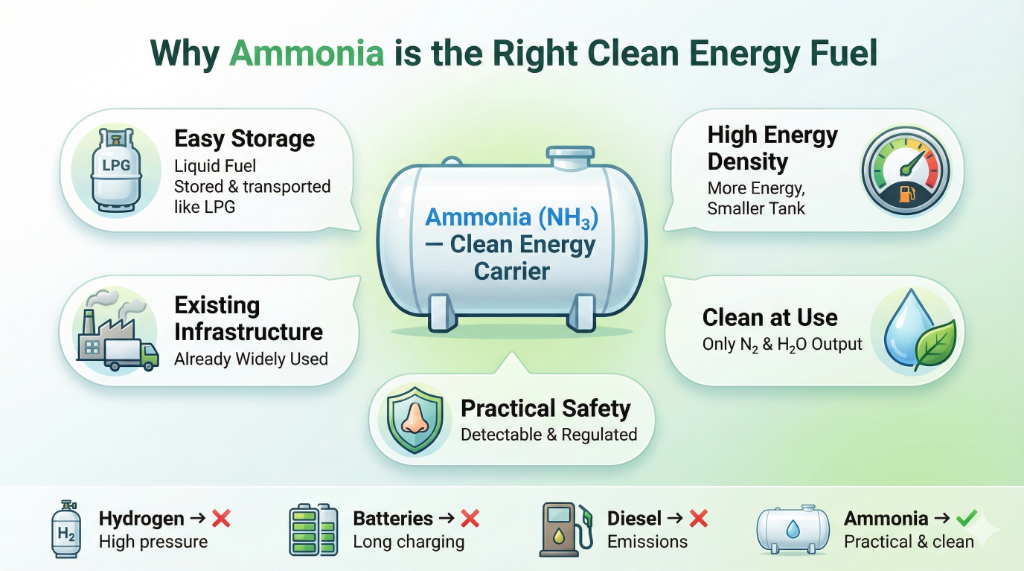
Ammonia is emerging as a powerful clean-energy carrier — not because it is new, but because it is practical, energy-dense, and already part of global infrastructure.
For Direct Ammonia Fuel Cells, ammonia enables clean electricity without hydrogen cracking, combustion, or high-pressure storage, making it suitable for real-world deployment.
Ammonia is a liquid at moderate pressure, similar to LPG. It has been safely stored, transported, and handled for over a century across agriculture and industry.
Why it matters: No cryogenics. No ultra-high pressure. No new fuel logistics.
Ammonia carries more usable energy per unit volume than compressed hydrogen, making it suitable for long-duration operation and mobility applications.
Why it matters: Longer range and longer runtime with smaller tanks.
India already has production, storage, and transport infrastructure for ammonia, used extensively in fertilizers and industry.
Why it matters: Faster adoption without building a new fuel ecosystem.
When used in a Direct Ammonia Fuel Cell, ammonia produces only nitrogen (N₂) and water (H₂O) — no CO₂ at the point of use.
Why it matters: Clean operation for cities, ports, and communities.
Unlike hydrogen, ammonia is easily detectable by smell, stored at lower pressures, and governed by established safety standards (similar to LPG).
Why it matters: Practical safety for everyday environments.